Tuesday, February 11, 2020

Preparing for My Birthday 2020

I’m putting an end to my health tech consulting and creating space for what comes next. Nurturing new things is not a part-time activity. Birth requires a commitment to create what comes next.

I’ll be doing one last round of on-line meetings with my health IT partners this month. After that, I’ll be available for continued friendship and touching base on the human aspects of our lives, not so much the organizational or technical parts, though sometimes those are inseparable. It’s awkward and scary to make this explicit, though it’s really how I’ve been functioning for the past few months.

I will have fully established this next phase by my birthday, 23 June 2020. It likely will include lots of art and a fuller integration of the many parts of my life (as a gay man, as a photographer, as a meditator, as a human engaged in the world).

After a lifetime of working in health IT, there are areas that I am still passionate about (health equity, technology that approaches magic).  Where these emerge organically, rather than as goals in their own right, they will surface on this blog.

Follow my journey at www.larrywolf51.com as well as on Instagram (@larrywolf5151).

I offer you this poem as inspiration.

Clearing — Martha Postlewaite

Do not try to save
the whole world
or do anything grandiose.

Instead,
create a clearing
in the dense forest
of your life
and wait there
patiently,
until the song
that is your life
falls into your own cupped hands
and you recognize and greet it.

Only then will you know
how to give yourself
to this world
so worth of rescue.


Wednesday, February 13, 2019

Taking My Own Advice

Chief Enthusiasm Officer - Adviser, Facilitator, Coach 

I'm at HIMSS19 in Orlando, putting my notes on Twitter, handing out my overgrown business card, catching up with friends and seeing what resonates.

The conversations that matter, where there is a heart connection:
  1. How can I help? ... Stay curious, stay engaged, see what opens up.
  2. Change out my photo to one that show's me glowing with energy.
  3. The only now is this one! People want to be more "meditative" and need encouragement to acknowledge the times that their mind and body are synchronized, when they are in the present moment. It's not about a still mind, it's about being alive. Let's not make our expectations of nirvana blind us to the life we're actually living. ... I may take a month to dive deep into stillness, but that's not the only time or way to be present.
  4. Break through the false ceilings! Regulations get interpreted very literally. Providers and vendors do the minimum to stay out of trouble. ... Along the way, we've put in place some powerful technology. Time to build on that and achieve the game changing value that's embedded in it. 
  5. It's about people and culture. Let's focus on what's working, where we have teams delivering care and improving people's lives, where we have tech that is invisible in how well it performs.
  6. Getting value from data is a soapbox I keep jumping up on... Find the patterns that matter to direction action.
  7. Too much data is un-mediated and we're drowning in a sea of riches... Use people + process + technology to make sense of it. Not one of those alone. 
  8. The person (their medical record) can be the textbook on what's good for them. More than genomics, this is about each of us being our own normal, about the tech finding our patterns, about the person being clear about our own goals and desired outcomes, having the tech guide our care team.
  9.  ... The list keeps growing 😀

At the Core - Where is the energy naturally arising?

Culture eats strategy for breakfast, lunch and dinner.
  • Clarify Mission & Vision
  • Build on Culture
  • Act Strategically
  • Adjust with Feedback
  • Deliver Results


Tuesday, April 11, 2017

National Academy of Medicine - Vital Directions for Health and Health Care

Introduction

Every once in awhile, the National Academy of Medicine (formerly known as IOM, the Institute of Medicine) has published an era-defining paper or book (for example: To Err Is Human: Building a Safer Health System (2000) and Best Care at Lower Cost: The Path to Continuously Learning Health Care in America (2013)).

On March 21, 2017, they issued a new report: Vital Directions for Health and Health Care (2017). It is the culmination of many workgroups over the past year or so. It brings together the thinking of a wide range of experts.

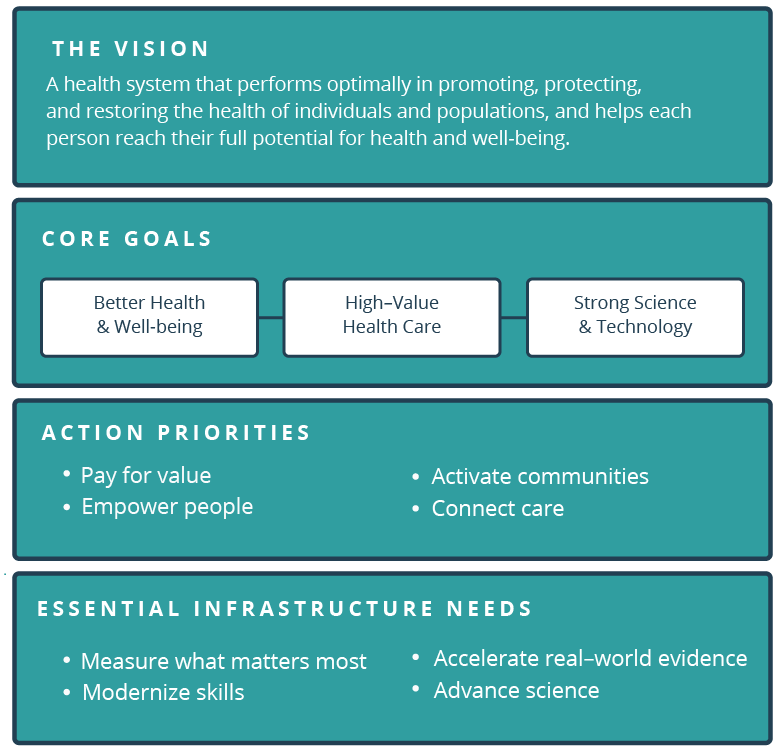
NAM Vital Directions - Overall Summary: Vision, Goals, Actions, Infrastructure


Better Health & Well-Being

A strong message of the report is to focus on better health and to look broadly at what that means and what leads to good health. 

Determinants of Health

NAM Vital Directions - Figure 5: The leading health determinants.
SOURCE: Adapted from McGinnis, 2002

The usual reaction to improving health is to jump to care as the primary driver of health. However, there is growing recognition that our health, and the health of the population as a whole, depends on much more: our genetics, our behavior and our social and physical environment. While the healthcare system can provide decisive intervention at critical moments, there are many other factors that must also be addressed. We have to address acute crises, chronic conditions as well as economic, social and educational status and access to services and information. Living a good life is about acting on the values of the individual and broad support provided by their multiple communities.

McGinnis, J. M., P. Williams-Russo, and T. R. Knickman. 2002. The case for more active policy attention to health promotion. Health Affairs 21(2):78–93.


An earlier post put forward the interaction of being, doing and environment. It reframes the determinants into three areas of influence - our inner experience, our actions and the world around us.

The Action Priorities 

The report has a long list of action priorities. Here are a few highlights.
  • Pay for value - Deliver better health and better results for all
  • Remove barriers to integration of social services with medical services
  • Link care and personal context
  • Ensure patient data access, ownership and privacy
  • Connect Care - Implement seamless digital interfaces for best care
  • Measure What Matters Most - Use consistent core metrics to sharpen focus and performance
  • Accelerate Real-World Evidence - Derive evidence from each care experience
  • Foster a culture of data sharing by strengthening incentives and standards
Future posts will address these and other areas of the report.


Wednesday, April 5, 2017

Notification Service - Who What Where When


Where is a person receiving care? Who is providing that care? What clinical or payment program is the individual in?
Notification Service receives updates about an individual and sends notifications

Knowing where an individual has received care or other services is perhaps the minimum necessary information for quickly assessing history. Knowing the care model (clinical and payment) provides the parameters for next steps. While this is a limited amount of information, it can be critical for taking action in a timely manner. It provides a key overview of relationships and supports many payment models. It is a core tool for care coordination and care management.

Updates include change in status, care provider or location, as well updates to descriptive information

  • Registration
  • Demographics
  • Admit or Discharge
  • Appointment 
  • Prescription Fill
  • Plan Enrollment
  • Program Attribution

A Notification Service

  • Receives updates from entities with relationships to the individual
    • Matches the individual in the update with known individuals
    • Enforces privacy rules
    • Maintains current and historical information on individual, entities and programs
    • Maintains the current and historical linkages between individuals and organizational entities
    • Maintains the current and historical linkages between individuals and programs
    • Sends notifications of updates to entities with relationships to the individual

    The core data include

    • Individual Demographics
    • Entity Demographics (the organization, for example, provider or payor, that is interacting with the individual
    • Program Definition (the "program" that the individual is in, could be a clinical program or a payment program)
    • The Individual-to-Entity Relationship
    • The Individual-to-Program Relationship


    This article from October 2016 describes notification services. Notification Service for Care Coordination in Value-Based Payment Models.

    Friday, February 10, 2017

    A Month of Meditation - January 2017


    I have recently returned from Karme Choling, a Shambhala Buddhist meditation center in Barnet, VT. I was one of the meditation instructors for the Winter Dathun, a month-long practice intensive.
    When I arrived, I wrote a short note of aspiration:

    • May I find personal healing. May I hold the space for others to heal.
    • May I be ordinary in this extraordinary time and place. May I mix the ordinary and extraordinary with mindfulness and kindness. May I take that out into the world to live in the mind of meditation long after leaving here.
    It was a powerful month of people gathering to meditate, to step into a place where they could settle, set aside the usual demands of life, and to experience their own being, one breath at a time, for day after day. It's amazing how people can open to themselves. 

    It was also a month of the ordinary. Leading yoga every morning. Finding time to do laundry. Making sure there was a supply of tissues in the meditation hall. Eating a meal. Taking a walk. Putting out the candles on the shrine at the end of the day.

    As I was preparing to leave, I wrote some additional aspirations:
    • May I be helpful. May I slow down, feel my heart, rest in the moment, act from stillness
    • May others feel their own brilliance. May they know kindness. May they know love. May they heal their hurts. May they be whole and fully alive.
    • May society call forth our collective wisdom. May we be one global village. May we be undaunted in our quests for greatness. May we live in peace.


    Thursday, September 8, 2016

    The Summer Blockchain Came to Healthcare

    This summer, there were visionary conversations about the future of health IT. A new technology may be the needed spark.

    ONC Challenge Grant

    In July, ONC challenged the health IT community for innovative ideas for apply blockchain. Blockchain, first introduced in 2008, is the technology behind bitcoin.

    The core capabilities of blockchain - a secure way to share data and track transactions - address the hot healthcare topics of interoperability and cybersecurity.

    ONC selected fifteen white papers as the winners of their challenge grants. The authors are healthcare providers, academic researchers, consulting powerhouses and individuals. The white papers address policy and technology. They span many use cases including medication reconciliation, clinical research, identity management, and claims processing.

    Upcoming Workshop

    ONC will be co-hosting a workshop with NIST, September 26 and 27, 2016 to explore blockchain in healthcare and where the selected white papers will be presented.

    Healthcare Needs Better Connections

    There are a wide variety of constituents in the health and healthcare ecosystem. The many ways they connect today is staggering, from dedicated point-to-point solutions to specialized clearinghouses to public Internet.
    Each participant has its own surrounding support network of services, supply chain, and numerous intermediaries. There are many opportunities to simplify the existing tangle of connections.

    Blockchain Attributes Address Healthcare Needs

    Blockchain brings together cryptography, peer-to-peer networks and highly distributed database technologies. This is the latest version of "the network is the computer," where now "the network" can take on many of the functions of a centralized clearinghouse, potentially replacing not just the centralized servers but also the centralized organization with a hyper-distributed model.

    Key attributes of blockchain include
    • Trusted Identity
    • Smart Contracts
    • Shared Ledger
    • Non-repudiation
    • Highly Distributed Redundant Data Store
    Blockchain could be a new platform for implementing solutions. Many of the specific aspects of blockchain are already being modified as different infrastructures are put in place (Ethereum, Gem, IBM, Microsoft, MIT).

    The Value of Hype: Vision and Alliances

    Hype is an indicator of new activity. That activity may or may not provide real value. Blockchain is the latest technological shiny object that has captivated the attention of innovators and early adopters. That attention may bring needed resources to address real problems.

    According to its proponents, blockchain has the potential to disrupt current processes and organizations, to create new wealth and shift the centers of power. Bitcoin and other crypto-currencies, despite ups and downs, are getting attention from financial institutions and governments as a means to improve trust, transparency and operational efficiency, especially with respect to clearinghouses, back office processes, audit and regulatory compliance.

    Let's not lose sight of the efforts already in place to provide better connections across the health ecosystem: the well established query capability of eHealth Exchange, the patient identity management in Commonwell, the broad adoption of ePrescribing using Surescripts, and the resilience of several of the state and local health information exchanges (HIE's). As we learned from Direct Trust, taking Direct Project from prototype to production, required more than just a core technical capability.

    The opportunity for innovation and the fear of disruption are generating a lot of attention. This in turn is leading to visions for a near term future with lower transaction costs and greater data fluidity. It has the potential to produce new value models. New alliances may form to harness the potential and old adversaries may work together. This is the case in financial services and may also apply to healthcare.

    Open Questions in Healthcare

    Regardless of technology, some areas, already active in health IT, need further work.
    • Value - Is there a direct line of sight from the technology to real value?
      • Value from information
      • Value to the end user
      • Value to the individual patient
      • Monetize data and information flow
    • Use Cases / Process Improvement
    • Applied Technology
      • Workflow - Does it fit with what the user is doing?
      • Data - Is the information useful to the action at hand?
      • Analytics - Has the relevant information been brought forward?
    Having these capabilities within a technology is not the same as providing a viable solution. Current problems, such as standards for granular data, usability of clinical systems and a longstanding culture of individual providers, all must be addressed.

    Perhaps the threat of disruption will motivate entrenched organizations to move forward on areas of cooperation, common standards, improved care coordination and research. These all areas where coming together and working together may be more important than the underlying technology.

    Assessing Progress

    Here are four key questions as we look for indicators of change.

    • Early Success: Does blockchain solve a specific, "micro-"problem in a way that has less friction, less cost, less overhead, is overall easier to implement and use, than current solutions to that problem?
    • Scale: Do the early success grow beyond the pilot user community?
    • Partnerships: Do new alliances form around blockchain and successfully address a previously intractable problem?
    • Scope: Does blockchain become a broad platform that enables a range of solutions or does it remain in a narrow niche? 


    Monday, May 23, 2016

    Change from the bottom: community nursing in the Netherlands

    Usually when we think of innovation, we assume that a small organization, even a single individual, will create something new, demonstrate it works, and then a large established organization will take it to scale. Very rarely will the innovators themselves grow to scale. In either case, the scaled-out innovation is supported by an organization with the usual management hierarchy and overhead.

    Here's an example of an innovative care model and an innovative management model. Both aspects focus on what really makes a difference, understanding what is essential for the organization to nurture its people and its customers, and what is something best left undone or done by others.

    This model for home health services builds on local teams of nurses who place high value on the relationships with the people they serve, favoring continuity of provider over specialized providers. It came out of nurse frustration with the fragmented care they had previously given.

    Buurtzorg is a community nursing organization in the Netherlands. It started small, focused on the needs of the professional care team and the people in their community. It puts the local team in charge of the care and how they run the team to provide that care.

    Buurtzorg provides high nurse satisfaction by "letting nurses be nurses", to build relationships with their patients, to be part of a small supportive team that shares the workload, to cover for each other, to build on each other's skills and knowledge, to access specialty resources as needed. A learning health system at the level of a team of ten or twelve.

    A trio of remarkable outcomes were achieved.
    1. Extremely satisfied patients with excellent outcomes and reduced home care costs (40% below the expected cost). 
    2. Extremely satisfied workers. Buurtzorg was the Netherlands Employer of the Year for three years in a row.
    3. Explosive growth, from the first team of 4 nurses in 2007 to 9,000 in 2015. Buurtzorg now provides 80% of the community nursing services in the Netherlands. This has occurred with almost no corporate overhead (a central staff of 50 or so including 15 team coaches).

    There are essential, but intentionally limited, services from a central support organization. A key central service is the team's coach, who facilitates communication within the team and helps them network with other teams, but who has no decision making authority.

    Buurtzorg Organizational Structure


    Shared IT focuses on
    • An electronic health record
    • A social network
    • A team dashboard
    There are some outsourced services, such as payroll and legal. Buurtzorg has taken to heart the guideline of keeping the services that differentiate the organization and having others do everything else.

    How to build on this?

    While Buurtzorg has changed the home healthcare experience and cost, the total cost of care, including all other medical services, such as physician and hospital care, on a risk-adjusted basis, were no different from the average in the Netherlands. Are similar innovations possible in other areas of health and healthcare?

    There have been studies of Buurztorg by many others from around the globe. What is special about community nursing in the Netherlands? How might this model be recast in other places?

    Here are some references on Buurtzorg.

    Buurtzorg Nederland (in Dutch. Google translates it remarkably well into English.)


    Public World Consulting (2015): Repository of all things Buurtzorg

    Frederic Laloux (2014): Reinventing Organizations (I first learned about Buurtzorg in this book on organizational paradigms. The information on Buurtzorg is spread throughout the book.).

    AARP The Journal (2013): Buurtzorg Nederland: Nurses Leading the Way!

    KPMG Insights (2013): Empowering caregivers


    Thursday, May 12, 2016

    ONC RFI Assessing Interoperability for MACRA - part 2 - ONC RFI

    Here's a summary of the Request For Information from ONC. Much of what follows is loosely quoted from the RFI, a Request for Information regarding assessing interoperability for the Medicare Access and CHIP Reauthorization Act of 2015 (MACRA). Comments are due by 11:59pm ET on June 3, 2016.

    MACRA and the ONC RFI both focus on measures of interoperability to be able to assess whether "widespread interoperability" has been achieved.

    As background and on-going framework, the RFI makes frequent reference to the Shared Nationwide Interoperability Roadmap version 1.0.  

    MACRA requires that the interoperability measures be established by July 1, 2016. This timeline effectively requires using metrics that are based on data which is currently being collected. Recognizing the limitations this time constraint creates, ONC also asks for comments about other metrics that might require more time to implement and would better measure the ambitious goal of widespread interoperability.

    MACRA defines interoperability as the ability of two or more health information systems or components to:
    1. Exchange clinical and other information and
    2. Use the information that has been exchanged using common standards to provide access to longitudinal information for healthcare providers in order to facilitate coordinated care and improve patient outcomes.

    The ONC RFI asks for comments in three areas:
    1. Measure population and key components of interoperability that should be measured
    2. Current data sources and potential metrics that address section 106(b)(1) of MACRA
    3. Other data sources and metrics ONC should consider with respect to section 106(b)(1) of MACRA or interoperability measurement more broadly

    1. Measure population and key components of interoperability 

    MACRA requires assessment of interoperability among meaningful EHR users and clinicians and health care providers with whom they exchange clinical and other information - their exchange partners. The exchange partners do not have to be meaningful EHR users themselves.

    ONC is looking to measure interoperability across populations and settings beyond that required by MACRA, as they have previously laid out in the Interoperability Roadmap. In the RFI, they ask for comments on this broader measure population.

    In keeping with the MACRA requirement, ONC further states that they are looking to measure not just exchange but use of information that has been exchanged.

    ONC proposes a framework for use:
    • Sending
    • Receiving
    • Finding (Request or Query)
    • Integrating or Incorporating
    • Subsequent use of information from other providers

    ONC is asking for comments to cover the following: 
    • Should the focus be limited to the MACRA requirements, Meaningful EHR users and their trading partners, or more broadly as laid out in the Interoperability Roadmap?
    • How should participants in the Merit-Based Incentive Payment System (MIPS) and Alternative Payment Models (APMs) be addressed?
    • Do the ONC components of sending, receiving, finding, integrating and using information meet the exchange and use requirements of MACRA?
    • Should the measurement be limited to certified EHR technology (C-EHR-T)? Measurement outside of C-EHR-T?

    2. Available Data Sources and Potential Measures

    ONC is looking at a combination of two perspectives
    1. By provider, based on the proportion of Meaningful EHR users exchanging information with other clinicians and subsequently using that information
    2. By transactions, based on the proportion of care transitions and encounters where information is electronically exchanged and used.

    The data sources being considered include
    [As an aside, ONC maintains a Health IT Dashboard across a variety of data sources.]

    2.1 Measures based on national survey data

    • Strengths: The surveys measure exchange with outside providers. Multiple years of survey data are available.
    • Weaknesses: self-reported data subject to bias and interpretation. Do not cover all providers. Do not provide transaction-level data.

    Survey measures under consideration include
    • Proportion of health care providers who are electronically sending, receiving, finding and integrating key health information
    • Proportion of health care providers who use the information they receive from outside providers for clinical decisions
    • Proportion of health care providers who electronically perform reconciliation of clinical information

    The survey results may provide insight into enablers and barriers to interoperable exchange.

    Questions about these survey measures:
    • Do the survey questions adequately address both exchange and use?
    • Could office-based physicians serve as adequate proxies for all Eligible Professions included in the EHR Incentive Program?
    • Do the surveys provide necessary information to determine why information may not be widely exchanged?

    2.2 Measures based on the CMS Medicare and Medicaid EHR Incentive Program

    The EHR Incentive Program is administered differently for Medicare and Medicaid. Provider-level data is collected by Medicare, but the states report Medicaid data as an aggregate. Changes in the data reported by the states would be required to get more granular, provider-level data.

    The interoperability objective of the EHR Incentive Program has limited scope, simple ensuring that a summary of care is sent, but not what was done by the receiving provider.
    ONC recognizes limitations in these data sets and is looking for comment on the strengths and weaknesses of these data sets as well as other data sets that could be sources for measuring interoperability.

    EHR Incentive Program measures under consideration include
    • Proportion of transitions of care or referrals where a summary of care record was created and exchanged
    • Proportion of transitions or referrals and patient encounters in which the health care provider receives, requests or queries for an electronic summary of care document (beginning in 2017)
    • Proportion of transitions of care where medication reconciliation is performed
    • Proportion of transitions or referrals where the health care provider performs clinical information reconciliation for medications, medication allergies and problem lists (beginning in 2017).
    ONC states that electronic reconciliation may include a combination of electronic and non-electronic information, but that it serves as a proxy for assessing electronic exchange.

    Questions about the use of EHR Incentive Program include

    • Do the potential measures adequately measure exchange?
    • Do the reconciliation-based measures adequately measure use?
    • What alternative measures (for example, clinical quality measures) should ONC consider to assess use?
    • Can state Medicaid agencies share health care provider-level data with CMS similar to how Medicare collects the data? If not, what are the barriers? What are some alternatives?
    • These measures assess interoperability across encounters or transitions of care. Would it also be valuable to develop measures of interoperability across health care providers, even if limited to the Medicare EHR Incentive Program?

    3. Other Data Sources and Measures

    ONC is looking for additional potential data sources and measures. For example

    • Medicare Fee for Service claims data
    • Performance data from other programs
    • Performance data from the Merit-Based Incentive Payment System (MIPS)
    • Performance data from Alternative Payment Models (APMs)
    • Electronically generated data from C-EHR-T or other systems

    Overarching Questions


    • Should ONC select measures from a single data source for consistency? Or leverage a variety of data sources? Would a combination of EHR Incentive Program and national survey data be appropriate? 
    • What, if any, other data sources and measures should ONC consider?
    • What measures might be provided by EHR vendors, Health Information Service Providers (HISPs), Health Information Exchange Organizations (HIEs, HIOs) or other organizations that enable exchange?
    • What information might be added by using measures based on Medicare Fee for Service claims?
    • Which are the highest priority measures to consider?
    • Address comments within the December 31, 2018 deadline for evaluating interoperability.
    • What might be useful for measuring interoperability more broadly?
    • How should ONC define "widespread"? What can be in quantifiable terms?

    Monday, April 25, 2016

    ONC RFI Assessing Interoperability for MACRA - part 1 - MACRA text

    On April 8, 2016, The Office of the National Coordinator for Health Information Technology (ONC) issued a Request for Information (RFI) regarding assessing interoperability for the Medicare Access and CHIP Reauthorization Act of 2015 (MACRA). Comments are due by 11:59pm ET on June 3, 2016.

    The MACRA legislation lays out a timeline for defining, assessing and acting on barriers to widespread interoperability.
    July 1, 2016: Establish metrics for widespread interoperability
    December 31, 2018: Determine if widespread interoperability has been achieved
    December 31, 2019: Identify barriers to widespread interoperability and recommend actions to address 

    Here's the relevant section of MACRA.  

    Medicare Access and CHIP Reauthorization Act of 2015

    SEC. 106. REDUCING ADMINISTRATIVE BURDEN AND OTHER PROVISIONS.

    (b) PROMOTING  INTEROPERABILITY OF  ELECTRONIC HEALTH RECORD  SYSTEMS

    (1) RECOMMENDATIONS FOR ACHIEVING WIDESPREAD EHR INTEROPERABILITY

    1. OBJECTIVE .—As a consequence of a significant Federal investment in the implementation of health information technology through the Medicare and Medicaid EHR incentive programs, Congress declares it a national objective to achieve widespread exchange of health information through interoperable certified EHR technology nationwide by December 31, 2018.
    2. DEFINITIONS .—In this paragraph:
    (i) WIDESPREAD INTEROPERABILITY .—The term ‘‘widespread interoperability’’ means interoperability between certified EHR technology systems employed by meaningful EHR users under the Medicare and Medicaid EHR incentive programs and other clinicians and health care providers on a nationwide basis.
    (ii) INTEROPERABILITY .—The term ‘‘interoperability’’ means the ability of two or more health information systems or components to exchange clinical and other information and to use the information that has been exchanged using common standards as to provide access to longitudinal information for health care providers in order to facilitate coordinated care and improved patient outcomes.
    1. ESTABLISHMENT OF METRICS .—Not later than July 1, 2016, and in consultation with stakeholders, the Secretary shall establish metrics to be used to determine if and to the extent that the objective described in subparagraph (A) has been achieved.
    2. RECOMMENDATIONS IF OBJECTIVE NOT ACHIEVED .— If the Secretary of Health and Human Services determines that the objective described in subparagraph (A) has not been achieved by December 31, 2018, then the Secretary shall submit to Congress a report, by not later than December 31, 2019, that identifies barriers to such objective and recommends actions that the Federal Government can take to achieve such objective. Such recommended actions may include recommendations—
    (i) to adjust payments for not being meaningful EHR users under the Medicare EHR incentive programs; and

    (ii) for criteria for decertifying certified EHR technology products.


    Tuesday, March 29, 2016

    Health = Being + Doing + Environment

    A framework for exploring health

    Health is a function of Being, Doing and Environment. I want to encompass the many ways we might define health, what we do about it and the activities that address health. The larger environment in which we live is also important. These interact and further shape each other.

    Health

    The circular flow of Being, Doing and Environment
    Health is a way of being and an attitude as well as a result of the actions we take or don't take and the environment in which we live.

    To say "I am healthy" is itself complex. Does it mean I feel well? That I have no limitations on my activity? That I am free of disease or disability? Or that I have accommodated and compensated for my various diseases and disabilities?

    Health is both broad and specific with a wide range of determinants of health. Here are a couple of examples work on this: Healthy People 2020 and Schroeder: We Can Do Better, Improving the Health of the American People, NEJM 2007.

    Being

    Who and what we are at this moment and the personal history that got us here.
    • Personal values and goals - what health is to us, what's important to us, what we want to experience, what we want to leave as our legacy.
    • Spirit - the innermost aspects of our being
    • Mind - our state of mind, attitude, outlook, intellectual capabilities, interests, desires, mental health.
    • Body - our physical body, it's current condition and history, our genetic inheritance, our various diseases and disabilities.

    Doing

    What we're doing now, our actions with ourselves, with others and in the larger world.
    • Plans - in the boundary between Being and Doing, our plans are how we go from our intentions to action, although not everything we do is planned.
    • Actions - what we're actually doing, with or without planning. The "behaviors" that are high on the list of health determinants and those that have no known effect on our health. 
    Included in here are the things we do to manage our health, from immunizations to exercise, from medication that changes our biochemistry to meditation that changes our mind, from surgery to assistive devices.

    Our actions affect others as well as ourselves. They also shape the larger environment, our own and others.

    Environment

    We live in an environment. The boundary between self and other is very fluid. We're completely interdependent with our environment. It's the context in which our actions take place. We can't take one breath without it. When we take advantage of it, the environment can make it easy to do the right thing, keep us safe and healthy, with no extra effort. On the flip side, the environment can be a real killer, from toxins that poison us to cultural norms that encourage risky behavior.
    • Physical Environment - from our housing and food, from our zip code to climate zone - the place where we live, work and play - and the physical forces that surround us. 
    • Social Environment - our family, friends and neighbors. We can't life without other people, from our conception and birth through the whole of our life. The social forces that we interact with our powerful in shaping our behavior and our health. 
    • Access to Resources and Services - access is a combination of what's available and at what cost... including healthcare, education, employment.
    • Public Policy and Public Health - what we collectively decide to do as a society
    • Extrasomatic Intelligence - a fancy way to say that using our environment well can make us vastly smarter, from the written word to the most advanced analytics.
    There's a lot being written about geography and health. Here's a start (Health Affairs Blog, August 6, 2015).

    A work in progress

    This is all a developing set of thoughts. I've had feedback about the diagram at the beginning of this post. More is welcome. I've received suggestions about the content. I'm not sure that Environment is the right label for the third section. Perhaps Connecting or Interacting or some other word that speaks to the interplay with the world around us.

    Feel free to comment here or on Twitter or LinkedIn. Thanks.

    Thursday, March 24, 2016

    Introduction to Agile Alchemy - a trial run

    My friend, fellow meditator and Agile software wizard, Stephen Starkey, and I are piloting a training program that combines meditation and Agile to help people be more present, better connected to the people and task at hand, and as a result, brilliant and productive.

    This first run will be a series of five Thursday evenings, April 14 through May 12, 2016. We'll meet in the West Loop at the Chicago Shambhala Center.

    This is a “beta” program. We are teaching something fresh, extending and combining elements we know well in a new way. We are looking for a small group of pioneers to join us in this exploration.

    Introduction to Agile Alchemy

    Agile Alchemy is for anyone who must collaborate with others to be successful. We take the world, full of chaos and change, and build on the natural strength and flexibility of mind, to fully engage with the present situation. Then we leverage that brilliance. We use the wisdom of the ages and modern times to work with complex situations with precision and grace.

    Agile Alchemy teaches:

    • Meditation and contemplation practice as a basis for deeper awareness and opening to possibilities
    • Tools for personal and organizational growth in areas such as:
      • Process design and stewardship,
      • Conflict resolution,
      • Leadership, and
      • Change management
    • Simple and powerful techniques for creating and maintaining clarity, momentum, and adaptability.

    This training program uses multiple perspectives:

    • The brain and individuals’ ability to think creatively,
    • Teams’ ability to deliver quality work, and
    • Organizations’ ability to set and achieve their goals.

    Program registration at Chicago Shambhala.

    A New Logo for Strategic Health Network


    What do you think?

    Monday, March 21, 2016

    HIMSS16 - Federal Initiatives

    It's been a couple of weeks since HIMSS16, nonetheless, a few comments are still relevant.

    HIMSS is an annual meeting of the tribe. We have matured as a community. There is a vast ecosystem of small, medium and large vendors. There is a broad Federal presence. There is a vibrant mix of start ups and long established players. There are many success stories from healthcare providers and also troubled implementations to learn from. This is a year of next steps.
    Twitter statistics: 1,184,883,357 impressions; 200,498 tweets; 30,341 participants; 137 average tweets per hour; 7 average tweets per participant

    It was a week of lively interaction, with 41,000+ of us in Las Vegas. There were over 200,000 tweets. What happened there was broadcast live across many channels. The continued growth of social media may have been the biggest news. #HIMSS16. The connections with peers that once required a live meeting now happen in virtual space every day.

    Plenty of technology

    It's time to declare victory on the technology side and move on to building the new world where clinical information is ubiquitous, available when and where needed, for an individual, for a population, for research, for managing processes, for continuous improvement, for a learning health system.

    Swimming in the water, we may not have noticed the transition from the fresh water of the river to the salt water of the ocean. While it is both blue (open to possibilities) and red (full of the blood of battling interests), the more important point is that it is an ocean, very different from the rivers that feed it.
    74% of physicians and 97% of hospitals
    ONC Report to Congress, February 2016, Possession of
    certified EHR among office-based physicians and hospitals

    We are in a new world, created from decades of pilots, early adopters, mainstream adopters, overlapping technologies, the explosion of consumer technology, the investment of HITECH, the continued achievement of Moore's Law.

    The rate limiting factors are our imagination, our creativity in adapting to the new capabilities, our willingness to progress in times of uncertainty - to manage change, to act and not wait for the next version (there will always be a next, newer, better version), our willingness to actively engage partners, our willingness to fully participate in new payment models.

    Alignment across HHS, between ONC and CMS, and with the rest of us

    The opening keynote was from HHS Secretary Burwell, with the value of EHRs in surfacing the drinking water issues in Flint Michigan. Flint is both an example of the success of health IT (that the records were available and searchable), and the potential to do so much more (real time public health surveillance).

    The conversation between Karen DeSalvo, the National Coordinator for Health IT (ONC), and Andy Slavitt, Acting Administrator for the Centers for Medicare & Medicaid Services (CMS), set the tone for where we are and what's to come: health IT is an enabler for healthcare reform.

    This year's discussion continues the collaboration from HIMSS15.

    Infrastructure

    Interoperability 

    • No one wants to be labeled a data blocker. After a year of heightened visibility, EHRs vendors have embraced various collaboratives to improve the exchange of information. Moving from press releases to working information exchange is going to take time and continued attention.

    App Challenge


    Monday, February 29, 2016

    An introduction

    It’s leap day and I’m heading to HIMSS16 in Las Vegas. A good day to reflect on the leap I’m taking in 2016, from the mothership of Kindred Healthcare to the speedboat of my own company, Strategic Health Network.

    Core personal values. Now that it’s my own company, all I have are my values backed up by my experience and brought forward by my actions.
    • Health
    • Meditative Awareness.
    • Collaboration
    Health is something we all have. Sometimes good, sometimes bad, but just being alive, being in the world, puts us on a journey of growth and change and, inevitably, death. Health is a combination of inner experience, outer environment and the ways we live our life. There are generations of human wisdom, from the scientific and medical worlds, the spiritual and philosophical to folk knowledge and our underlying biology. I look at my own health, the things that make a difference or once made a difference, the ways in which I age, the health of those around me. We have bodies. That is at the core of our being. It is our life.

    Meditative Awareness. Meditation is a natural aspect of being human. I have been an on-again off-again meditator for 40 years. I’ve come to appreciate the power of silence, of taking time to observe, of allowing thoughts to come and go without becoming overly attached. Simply being present. Action only happens in the present moment. Being deeply present means that intuition and cognition are aligned and available as the situation demands. It takes a willingness to appear foolish, to even be a fool. It takes endless fresh starts. It takes friendliness to ourselves and others. It takes practice and discipline.

    Collaboration. The world is completely interdependent. We are islands and bridges, oceans and ships, safe harbors and perilous storms. Whether we come together to compete or to cooperate, we exist in interaction. Everything, from the plane I’m flying in, the Internet that will distribute these words to you to the English language I’m using, is the result of collaboration among humans. More than simply getting a job down, collaborative work is an opportunity to bring out the brilliance in each other, to build on our different perspectives, find common ground and celebrate our diversity. 

    As a company, how do these come together?
    • Strategic
    • Health
    • Network
    Strategic. The pivot points. The context in which action takes place. We can both ride the big waves and direct where we are going. We can work with the constraints and the opportunities. There is strategy at all levels. Let’s be smart about what we are doing. Apply the most leverage. Learn from observing keenly. Modify action based on experience. Whether it's a line of code or words of a regulation, details matter but only in service of the larger goal. Ends and means must work together.

    Health. I have spent almost my entire adult life working within or providing services to large healthcare providers. It is all too easy to get swept up in providing care and lose sight of the real goal, health. As an individual and a company, I commit to staying focused on improving health.

    Network. I have been a network guy from way back, connecting people, connecting ideas, creating wholes that are greater than their parts. Mind maps, data graphs, social interactions, connected computers. I’ve spent the past decade in the web of committees, collaboratives and multiple partnerships - connecting care and shaping national health information technology policy, from pilot demonstrations of interoperability - information following the patient throughout the care process - to chairing advisory workgroups recommending the broad inclusion of all providers in health IT initiatives. 

    Software Technology has been the subtext of my life for 49 years (yikes!). I wrote my first program in the summer of 1967 thanks to funding from the National Science Foundation. Writing code and making sense of data was magic that I could harness. That summer changed my life. My life changed again, in 1976, when I joined a research project at the University of Vermont, creating an electronic health record, under the guidance of a visionary leader, Dr Larry Weed.

    This blog will dive into these themes and more. Welcome to my world.

    Larry in Vermont, 1979.